Copy Sera.
Include Sera on meetings and important email threads your organization should not lose.

Every meeting, every decision, every role change: Sera organizes it from the emails and transcripts you already produce. Your reviewer approves what becomes trusted. Your organization stops starting over.
Include Sera on meetings and important email threads your organization should not lose.
She prepares decisions, tasks, roles, policies, people, projects, and risks for human review.
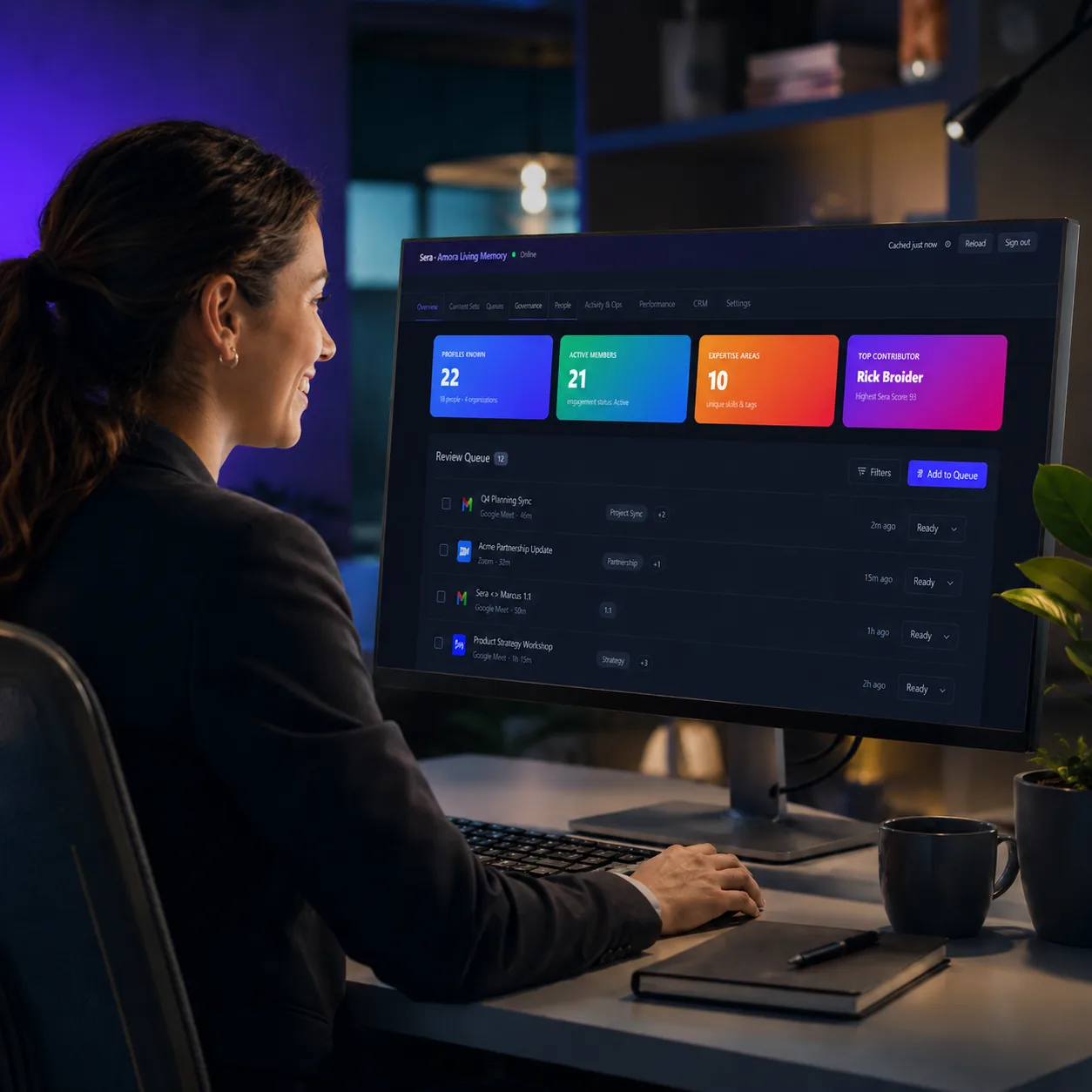
Your team reviews every record before it becomes organizational truth. Nothing is trusted automatically.

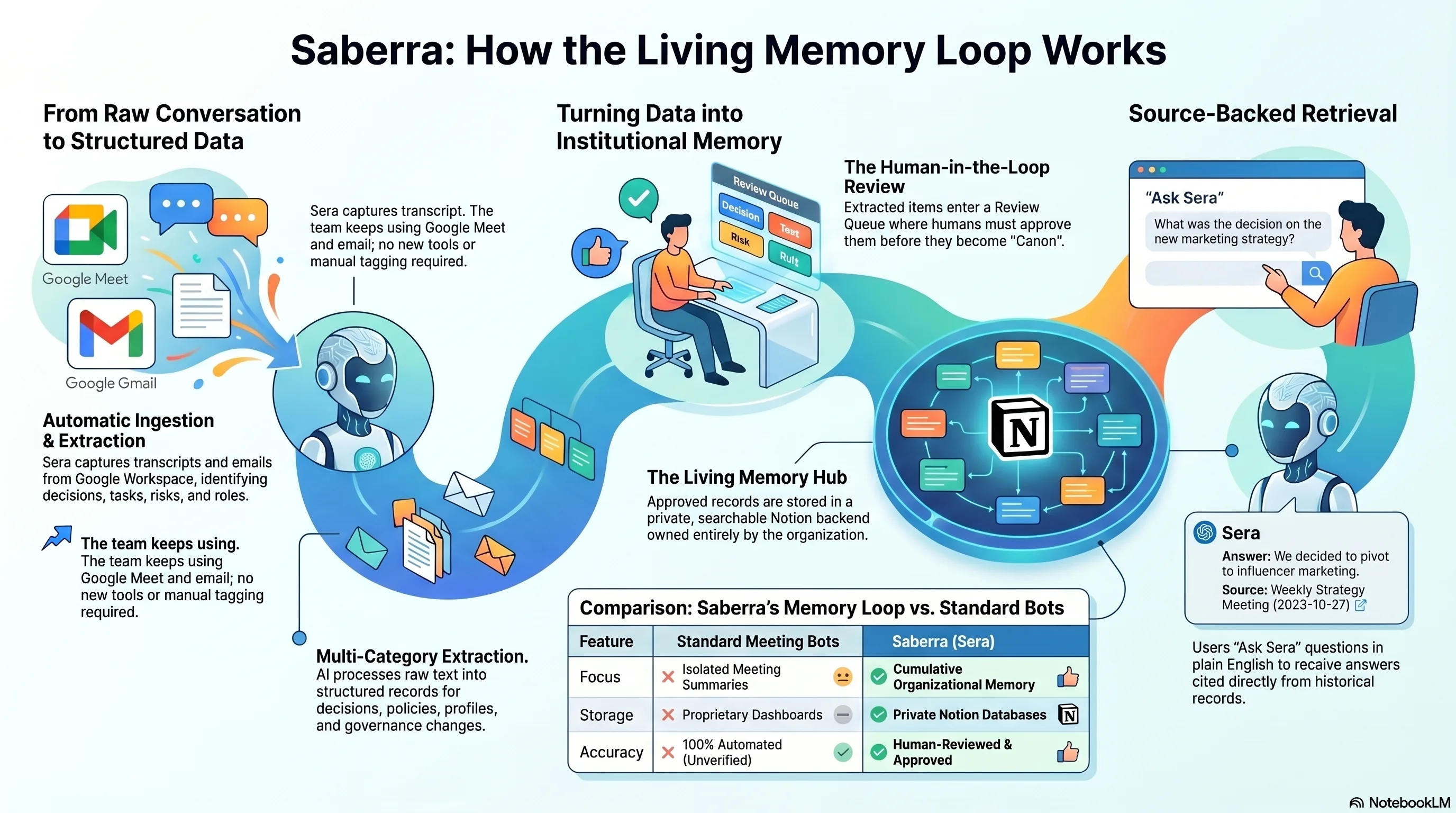
This infographic shows the deeper path from raw meetings and emails to human-approved records in the Living Memory Hub, then back out through source-backed Sera answers.
 Tap to enlarge
A dedicated inbox receives Google Meet outputs and important operational email. Sera proposes structured records. A human reviews the queue. Approved records become the source Sera can answer from.

Meetings and emails become structured enough for review, retrieval, governance, source-backed answers, and actual follow-through.
What was agreed, when it changed, and where the source lives.
Action items with owners, dates, status, and meeting context.
Concerns that surface in conversation before they become expensive.
Defined accountabilities, domains, and ownership history.
Who holds what, since when, and under what conditions.
Profiles, relationships, and interaction history.
Governance and operating agreements with review status.
Draft changes, objections, and reviewable canon updates.
Useful summaries connected to structured records.
Initiatives, commitments, risks, and decision history.
Relationship context, follow-ups, and stakeholder history that should not live only in one person's inbox.
Lessons, context, practices, and reasoning worth preserving.
Audit trail for every captured item and every review path.
Saberra does not make your organization's history a black box. Sera surfaces what happened. Your people decide what becomes trusted organizational truth. Every record is inspectable, editable, and source-backed.
| Dimension | Standard meeting bots (Fireflies, Otter, Fathom) | Saberra |
|---|---|---|
| Focus | Isolated meeting summaries | Cumulative organizational memory |
| Storage | Proprietary vendor dashboard | Private Notion workspace you own |
| Accuracy | 100% automated, unverified | Human-reviewed and approved |
| Memory type | Per-meeting, searchable notes | Decisions, tasks, risks, roles as structured records |
| Retrieval | Re-read transcripts manually | Ask Sera, she answers with source citations |
| Transition coverage | Context still leaves with the person | Approved records persist through every role change |
Ten questions. Specific results by segment. Find out exactly where decisions, roles, and context are leaking, before the next transition makes it more expensive.